The Next Enterprise Moat
Insights from Fabrica Ventures Team.

First Who… Then What
July 31, 2026
A GOAT of Investing on AI
August 16, 2026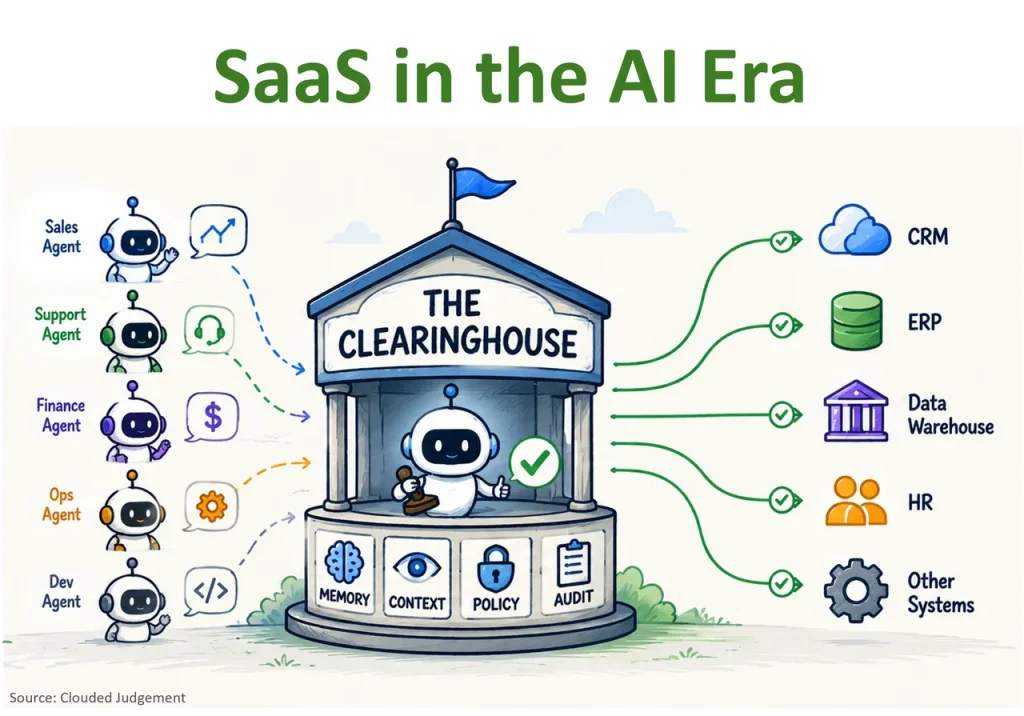
Based on my presentation at SP2B in São Paulo on August 10, 2026.
Who will own the next enterprise software moat? The answer may define the biggest software winners of the next decade.
During the SaaS era, the answer was surprisingly simple. The winners became Systems of Record. Salesforce for customer relationships. Workday for HR. SAP for ERP. ServiceNow for IT.
Their competitive advantage was obvious: they stored the enterprise’s most valuable data. Once every workflow depended on that data, switching became incredibly difficult.
The moat was the database.
AI is changing that equation.
As enterprises deploy dozens—or eventually hundreds—of AI agents from different vendors, storing data will no longer be enough.
The critical question becomes: Who decides what every AI agent can know, see, and do?
I believe a new software layer is emerging: the AI Clearinghouse. It orchestrates enterprise intelligence by controlling memory, context, execution, and governance. Every AI agent passes through this layer before acting.
Over time, the AI Clearinghouse accumulates something even more valuable than enterprise data: the history of enterprise intelligence — every decision, every interaction, every successful workflow, and every mistake.
That may become the strongest competitive moat of the AI era.
Today, four camps are racing to own this position.
LLM providers such as Anthropic (a Fabrica Ventures portfolio company) and OpenAI are moving downward from intelligence. Data platforms like Databricks (also a portfolio company) and Snowflake are moving upward from enterprise data. Application platforms such as Salesforce and Intercom (another portfolio company) want users to launch AI where they already work. Finally, agent-native platforms like Palantir and Workato (both former/current portfolio companies) are building orchestration layers across enterprise systems.
The winner may become the System of Record of the AI era.
This transition also changes software economics. For nearly three decades, enterprise software was sold per seat. AI agents don’t buy seats—they perform work. Pricing naturally shifts toward tasks completed, outcomes delivered, or tokens consumed. Customers are no longer buying software. They are buying work.
Conclusion
For investors, this architectural transition matters more than the latest AI model announcement.
That remains the ambition of Fabrica Ventures Fund III: to back the companies building the next enterprise moat.