When Private No Longer Means Illiquid
Insights from Fabrica Ventures Team.

Nobody told San Francisco there is an AI Bubble
September 13, 2026
A Número 1
September 25, 2026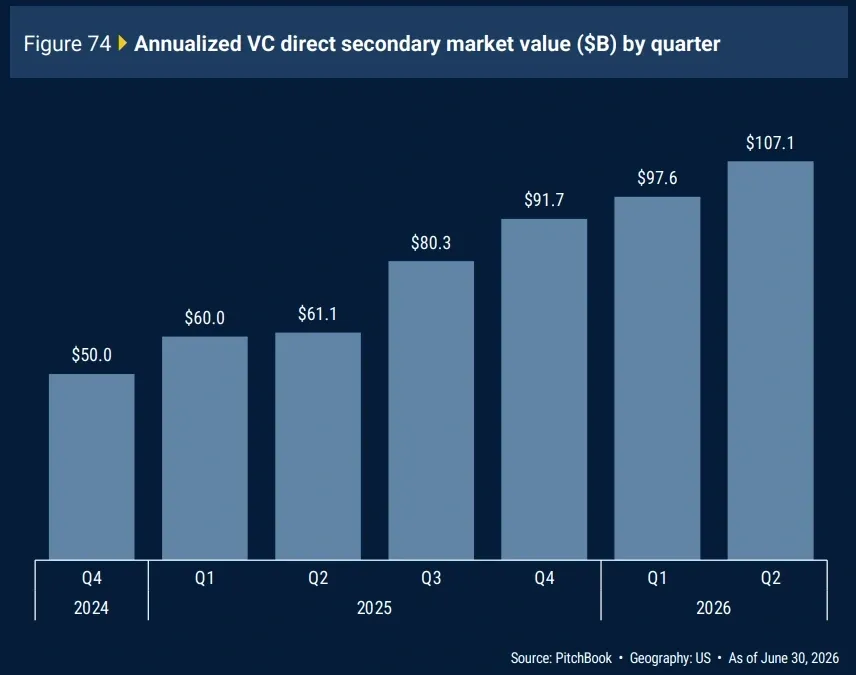
Something important has changed in the US private secondary market since 2024, both in volume and in the quality of deal flow.
There are now 950+ unicorns in the US, many of them born during the ZIRP era. Unicorns are the primary drivers of venture fund returns, but much of that value remains trapped in portfolios as companies stay private longer and delay their exits.
Over 40% of US unicorns have now been in venture portfolios for at least nine years — approaching the typical 10-year life of a VC fund.
This creates an increasingly obvious mismatch. As funds approach or exceed their 10-year lives, many of their biggest winners remain private. The value may be there, but the liquidity is not. A large share of venture returns therefore remains on paper precisely when LPs are expecting distributions.
In addition, liquidity remains top of mind as investors look to rebalance portfolios for two main reasons: (i) to reposition out of non-core investments and into emerging technologies and newer areas of conviction, and (ii) to mitigate concentration risk in big winners, where early investors have seen position sizes grow rapidly with the pace and scale of recent AI financings.
That pressure is transforming the secondary market.
The US venture secondary market reached an annualized $112.2B in transaction value in Q1 2026 ($97.6B direct), surpassing public listings as a source of liquidity for the first time. As companies continue to stay private longer, secondary transactions are becoming a core component of liquidity planning rather than simply an alternative to traditional exits.
Historically, secondary transactions were often associated with distressed sellers, discounted positions or companies with uncertain exit prospects. Increasingly, the opposite is true. Some of the most sought-after private technology companies now have active secondary markets, driven by employees, early investors and venture funds seeking liquidity or portfolio rebalancing.
Company-sponsored tender offers have also become more common, providing liquidity to employees and early shareholders without requiring companies to go public or pursue a traditional exit.
On the other side of these transactions, dedicated secondary funds are expanding, among them Fabrica Ventures. However, secondaries remain highly concentrated in a handful of names. On Hiive, the top 20 startups accounted for 86% of secondary trading value in Q2 2026.
Conclusion
Exit momentum is building. PitchBook’s Exit Predictor identified 110 companies with a high likelihood of going public within the next three years.
However, the IPO window is not yet open enough to entice many companies to go public. Companies could exit, but often at the cost of lower-than-peak valuations or volatile post-listing performance.
At Fabrica Ventures, we have seen firsthand how the development of the secondary market can accelerate liquidity. According to Carta, Fund I ranks in the top 20% of its vintage in DPI, while Fund II ranks in the top 1%.
Importantly, these distributions have come while many of our strongest investments remain private.
For us, that is perhaps the clearest evidence of how much the market has changed. Secondaries are no longer simply a bridge until the IPO window reopens. They have become an increasingly important source of liquidity in their own right.
All data from Pitchbook, except where otherwise indicated