
The Art of Pricing an IPO
Insights from Fabrica Ventures Team.

The Power Law of Adventurers
November 7, 2026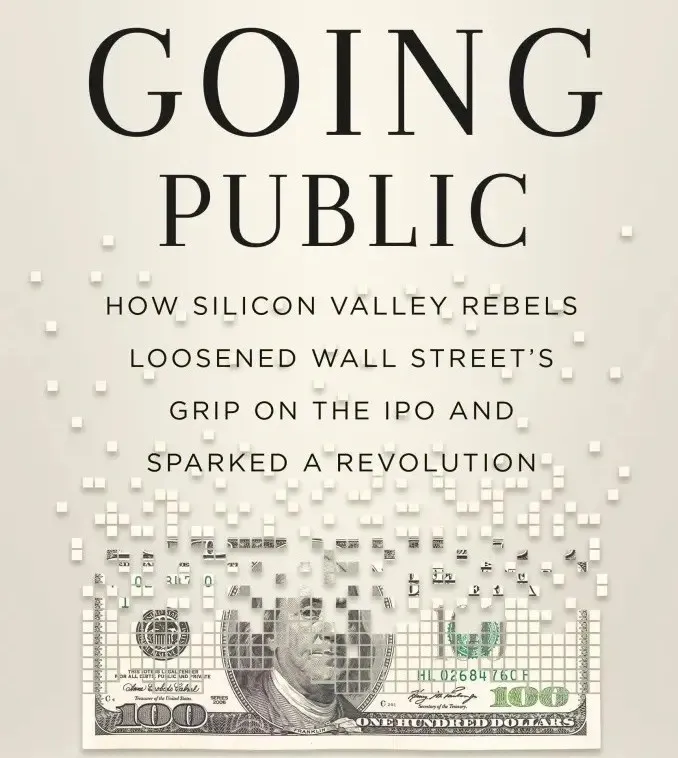
Going Public: How Silicon Valley Rebels Loosened Wall Street’s Grip on the IPO and Sparked a Revolution, by Dakin Campbell, offers an interesting behind-the-scenes look at some of Silicon Valley’s most high-profile IPOs.
The book explores a longstanding conflict between Silicon Valley and Wall Street: who should capture the value created when a private company goes public?
Historically, the IPO process has concentrated considerable power in the hands of Wall Street investment banks, particularly Goldman Sachs and Morgan Stanley, which have long dominated the underwriting business.
These banks face an inherent tension.
On one side are companies going public, seeking to maximize the proceeds from selling their shares. On the other are large institutional investors, such as Fidelity, with whom the banks maintain continuous, long-term relationships.
The banks must balance these competing interests, finding an offering price attractive enough to generate strong institutional demand while delivering satisfactory proceeds to the issuing company.
But there is an important asymmetry: A company goes public only once. Institutional investors participate in IPOs repeatedly. And therein lies the conflict.
For decades, many Silicon Valley founders and investors have watched their shares surge on the first day of trading, only to realize that billions of dollars might have been left on the table.
The money did not disappear. It was effectively transferred from the issuing company and its selling shareholders to investors fortunate enough to receive allocations at the IPO price.
Spotify challenged this model with its direct listing in 2018, bypassing traditional underwriting allocations and allowing market forces to establish the opening price. Other companies have experimented with alternative approaches, but none has fundamentally displaced the traditional IPO model.
Which brings me to Anthropic, a Fabrica Ventures portfolio company.
I believe Anthropic has approached its IPO valuation exceptionally well, for three reasons.
First, an attractive valuation relative to OpenAI.
At ~$1.4T, Anthropic’s IPO valuation is broadly in line with OpenAI’s recent private funding round, despite Anthropic being ~70% larger in revenue. In other words, public-market investors are being offered a substantially lower revenue multiple for a larger business.
Second, extraordinary demand and the importance of a successful debut.
Anthropic is set to become the first major AI-native company to go public. Its performance will therefore carry significance well beyond its own shareholders, potentially establishing a valuation benchmark for the entire AI industry.
The IPO has reportedly been approximately six times oversubscribed, representing more than $350B in investor demand.
Oversubscription does not guarantee strong aftermarket performance, but it is a powerful indication of institutional appetite. More importantly, it suggests that Anthropic has found a valuation that leaves room for public-market investors to participate in its future growth.
Third, a carefully structured lockup expiration.
One of the recurring challenges of high-profile technology IPOs is the expiration of shareholder lockups, when large volumes of previously restricted shares can suddenly become eligible for sale.
Anthropic has addressed this issue through a staggered lockup-release structure, effectively creating a waterfall of potential share supply rather than a single massive expiration event.
This approach should help mitigate selling pressure and reduce the risk of sharp volatility around lockup expirations.
Conclusion
Taken together, these three decisions suggest a remarkably thoughtful approach to going public by Anthropic.
The goal should not be to maximize the IPO price at any cost. It should be to establish a sustainable market valuation that rewards existing shareholders while giving new investors a compelling reason to own the stock.