Fin Exit: Only Charge Your Customers If You Make Them Happy
Insights from Fabrica Ventures Team.

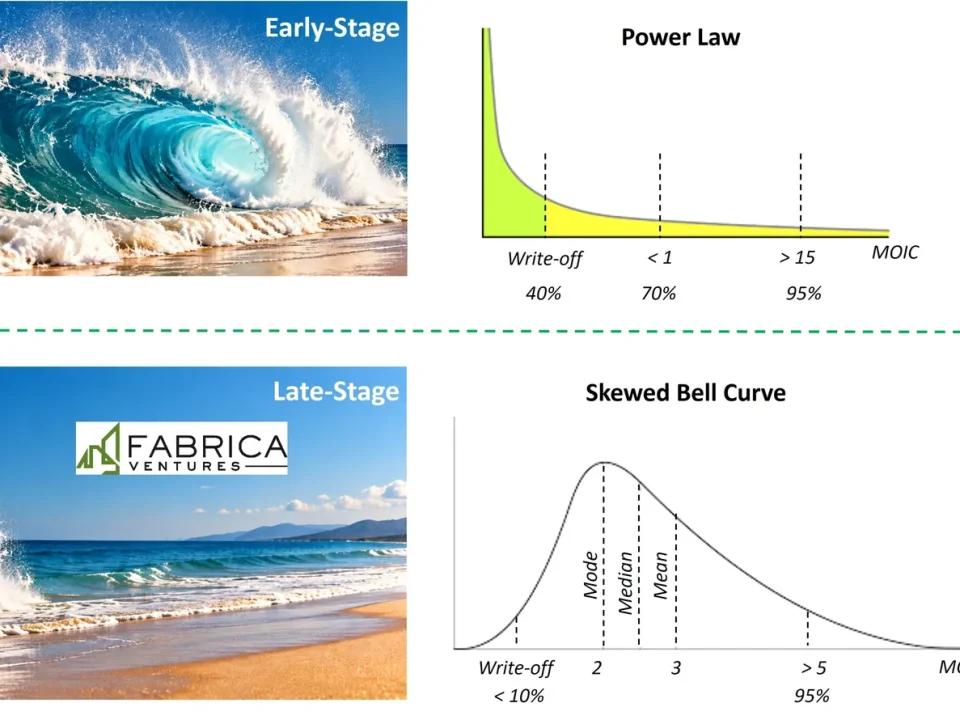
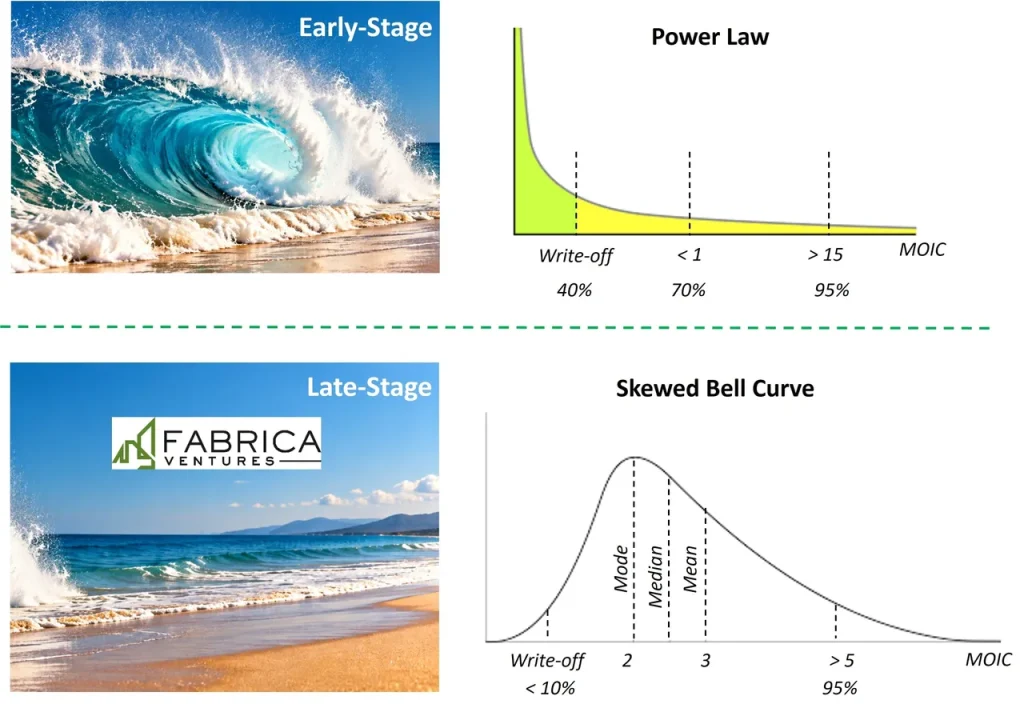
Power Law vs. Skewed Bell Curve
October 1, 2026
Intercom — now officially called Fin, after its AI customer service agent — is a leading customer support platform.
As previously announced, Salesforce (NYSE: CRM) acquired Intercom for $3.6B in June 2026, with the distribution originally expected between November 2026 and January 2027.
To our surprise, the distribution arrived last week, earlier than expected, resulting in a 2.9x MoIC and an IRR of more than 37% for Fabrica Ventures.
But beyond the return, there is something particularly interesting about Fin: how it gets paid.
Intercom was one of the first large software companies — with ~US$400 million in ARR — to embrace an outcome-based pricing model for its AI product. Instead of simply charging a fixed monthly fee for access to the software, Fin charges $0.99 for each customer inquiry it successfully resolves.
In other words, customers pay when they receive the outcome they — and their own customers — actually want: a resolved conversation.
That pricing model has several advantages:
1) Make it an obvious buy with pricing that starts at $0
The cost-per-resolution structure dramatically reduces the financial risk of adoption. If Fin doesn’t resolve customer issues, customers don’t pay for resolutions. That lowers the psychological barrier to trying the product while also signaling confidence: Fin makes money when Fin works.
2) Align your financial incentives with customer value
Outcome-based pricing directly links Fin’s revenue to its customers’ success. The better Fin becomes at resolving customer issues, the more valuable it becomes to customers — and the more revenue it generates. Instead of simply selling access to software, Fin ties its revenue directly to the outcome it delivers.
3) Let customers use it when they need it — and not when they don’t
Usage-based pricing also gives customers flexibility. Some businesses have highly variable support volumes, while others may want AI to handle only certain types of conversations. Fin doesn’t have to be an all-or-nothing proposition. Customers can deploy it where it makes economic sense and pay according to the results it delivers.
Conclusion
Fin embodies one of the most important credos at Fabrica Ventures: skin in the game.
(On this topic, in a future post we will delve into the American waterfall for carry, adopted by most US VC funds, versus the European waterfall, which Fabrica adopts.)
And there is something equally powerful about the story of founder and CEO Eoghan McCabe, who left Ireland for San Francisco with little money and the guts to embrace a skin-in-the-game pricing model.