A Número 1
Insights from Fabrica Ventures Team.

When Private No Longer Means Illiquid
September 19, 2026
One of the themes that has come up repeatedly during our Fund III roadshow is the changing role of liquidity in venture capital.
Company-sponsored tender offers have become increasingly common, providing liquidity to employees and early shareholders without requiring companies to go public or pursue a traditional exit.
A good example is OpenAI. Last month, the company reportedly bought back roughly $7B of shares from employees, giving them an opportunity to cash out part of the wealth they had accumulated while building the company.
Databricks (a Fabrica Ventures portfolio company) provides another striking example. In late 2024, the company raised $10B at a $62B valuation — it is now valued at $190B! — with most of the capital intended to provide liquidity to employees.
And that pressure is understandable.
More than 40% of US unicorns have now been in venture portfolios for at least nine years. As companies remain private for longer, employees can spend many years accumulating options and shares without having a practical way to turn them into cash.
For an engineer who joined a startup eight years ago, the company may have gone from a $500M valuation to $20B. On paper, that employee may have accumulated substantial wealth. In practice, much of it remains locked inside an illiquid private company.
At some point, employees want to buy a house, diversify their wealth, pay taxes, or simply realize part of what they have spent years building.
That is where tender offers are changing the equation.
They are increasingly becoming a bridge between two worlds: companies that want to remain private longer, and employees and early investors who cannot necessarily afford to wait indefinitely for an IPO.
And this has another important consequence: tender offers are becoming an increasingly important source of high-quality deal flow for the private secondary market, where Fabrica Ventures has been an active participant.
Finally, the infrastructure supporting tender offers is getting better. In the first half of 2026, Carta (a Fabrica Ventures portfolio company) administered more than 70 tender offers representing $3B in transaction volume — its strongest first half on record.
Conclusion
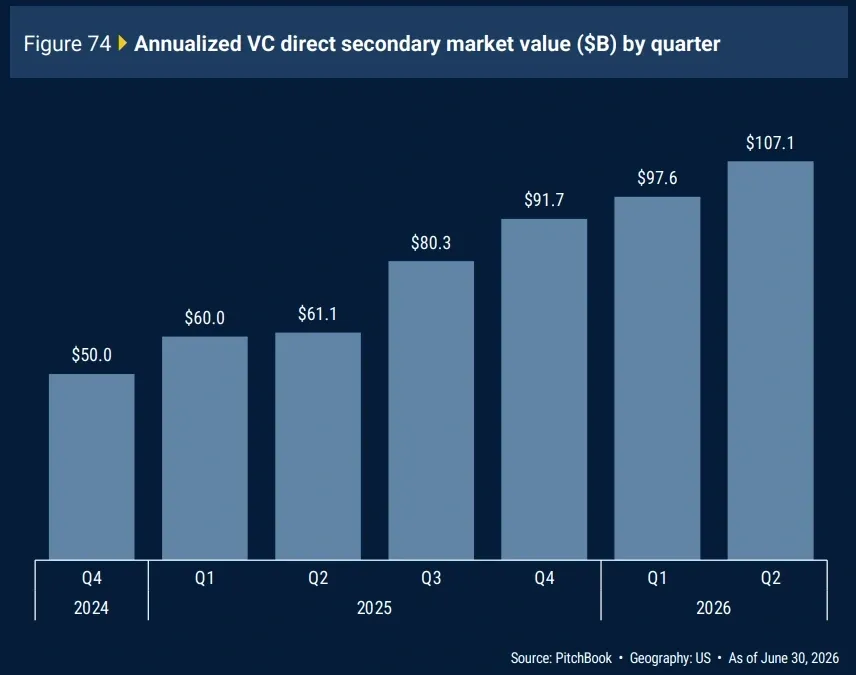
The VC secondary market is getting stronger and stronger.
At Fabrica Ventures, we identified this trend early. And identifying trends before they become obvious is, after all, at the heart of venture capital.
We have been investing primarily in secondaries since our first fund and have established Fabrica Ventures as the First secondary-focused venture fund built by Brazilians. And we did it from Silicon Valley, at the center of the market we invest in.
Tender offers are another sign that what was once a relatively small corner of venture capital is rapidly becoming part of its mainstream infrastructure.
And with Fund III, we will continue to capitalize on the advantage of being First.