Nobody told San Francisco there is an AI Bubble
Insights from Fabrica Ventures Team.

When Is Circular Financing a Bubble?
September 4, 2026
Packed around a table this week at Wayfare Tavern in San Francisco’s Financial District, only two things were being talked about: the 20% increase in rents over the last few months and the Goldman Sachs mega tech conference taking place at the Moscone Center.
The two themes may be more connected than they seem. San Francisco is booming again, now thanks to AI. And if you distilled what was said at the conference into one message, the AI boom is just beginning:
1. The AI infrastructure buildout is getting bigger, not slowing down. It is expected to become a $3-4T AI infrastructure opportunity through 2030. More interestingly, the bottleneck increasingly isn’t chips — it is power, land and data-center capacity.
Just to give an idea of the scale, firm orders for behind-the-meter AI compute power alone are approaching the electricity generation capacity of Brazil.
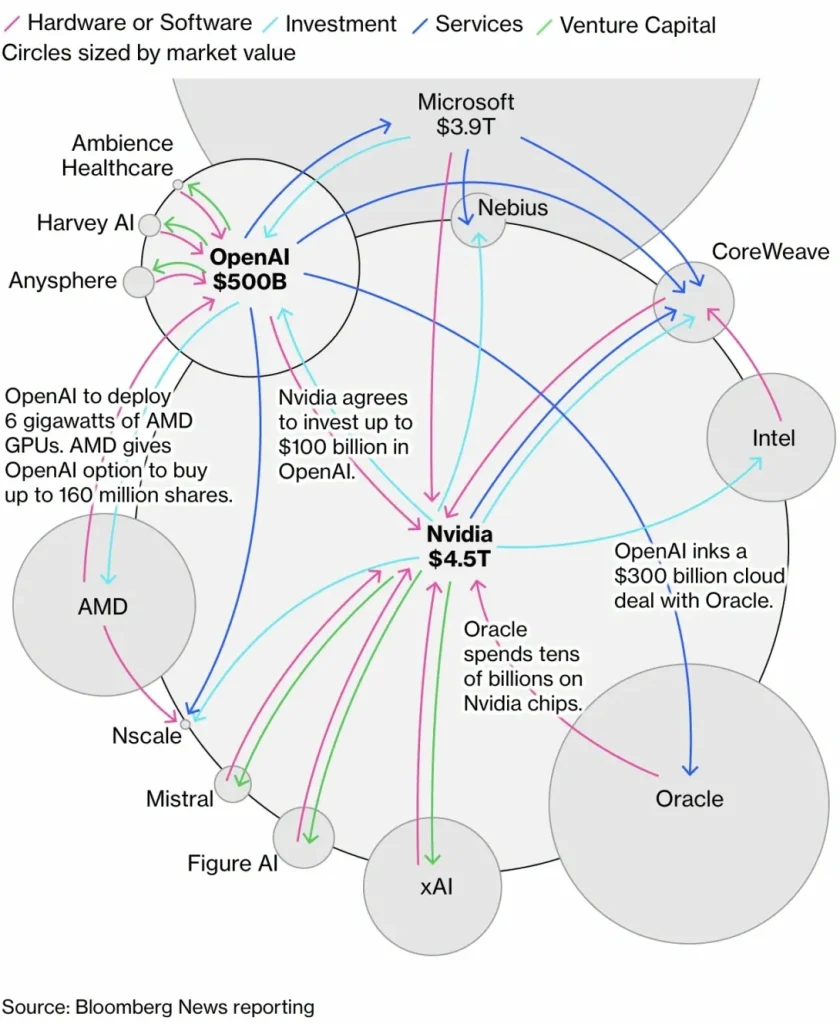
2. Coincidentally, Jensen Huang directly addressed “circular financing,” the subject of my previous post, When Is Circular Financing a Bubble?
Asked whether Nvidia’s investments constitute circular financing, Huang replied: “We put in one and 100 comes back in. Is that circular?”
But his underlying argument was more important. Nvidia puts in a relatively small amount while projects attract vastly larger amounts of outside capital. And, importantly, financing does not come together without offtake commitments from customers.
In other words, financing is not creating the demand; it is financing demand that already exists.
3. AI infrastructure is becoming an asset class. This may be the most consequential financial-market development. Nvidia has partnered with Apollo, BlackRock, Blackstone, Brookfield, Goldman Sachs and KKR on platforms intended to mobilize more than $500 billion of third-party capital for AI infrastructure.
That means we are moving from tech companies buying GPUs to something resembling the financing of power plants, telecom networks and other infrastructure. For a VC/investment audience, this is a fascinating transition: compute is becoming financeable infrastructure.
4. The next AI story is enterprise adoption, not just bigger models. Databricks (a Fabrica Ventures portfolio company) was particularly interesting here, with AI moving into enterprise workflows and proprietary data.
This fits perfectly with two themes discussed here before: the forward-deployed engineer model and automated professional workflows.
5. Perhaps the most interesting comment did not come from an AI CEO. It came from Goldman Sachs itself. Goldman’s investment-banking leadership argued that the debate over whether AI is a bubble may be asking the wrong question. The more important question is whether AI will fundamentally change how companies operate, compete and create value.
And, yes, they called it an AI investment supercycle.
There will unquestionably be excesses. But the existence of speculative excess does not make the underlying technological transformation speculative.
Goldman’s leadership also questioned whether traditional ROI models can fully capture the payoff from AI: “Everyone wants a spreadsheet — but there is no spreadsheet for this.” Companies may increasingly have to invest in AI not because they can precisely calculate the return, but because the cost of not investing is becoming competitively unacceptable.
Conclusion
If San Francisco is in an AI bubble, nobody seems to have told San Francisco.