
When Is Circular Financing a Bubble?
Insights from Fabrica Ventures Team.

Unbubbling the Mainstream AI Bubble Narrative
August 28, 2026
Nobody told San Francisco there is an AI Bubble
September 13, 2026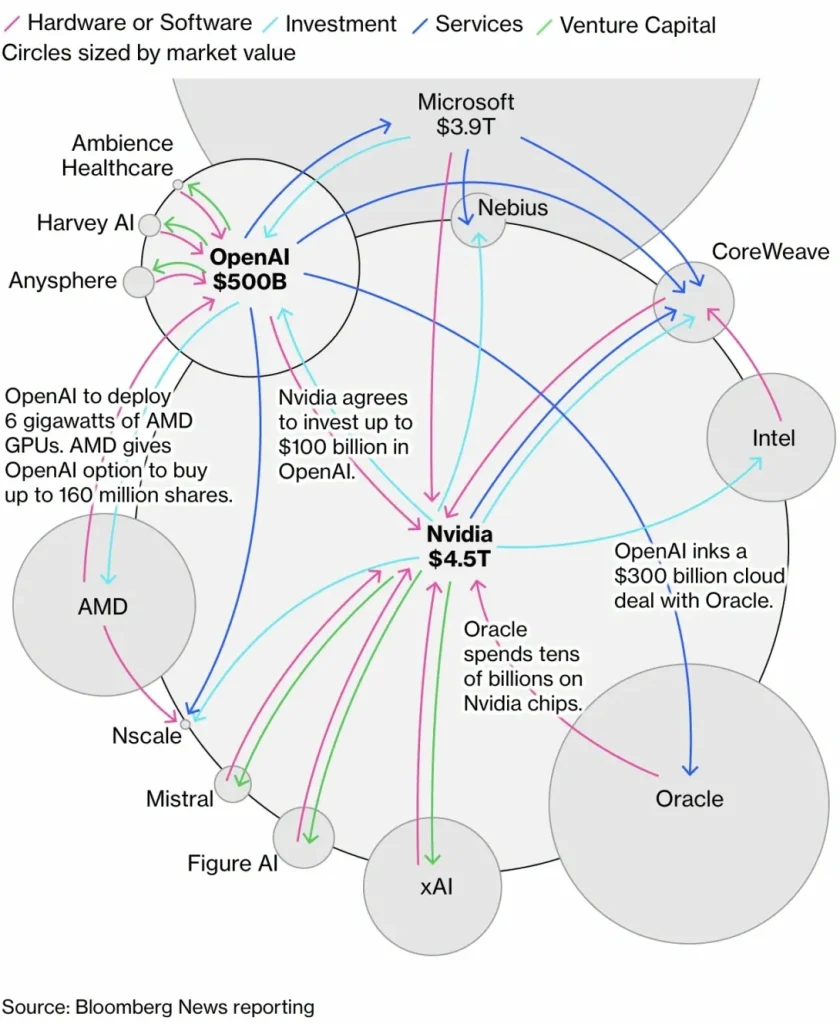
There has been much talk about “circular financing” in AI — usually presented as yet another piece of evidence that the industry is in a bubble.
The argument goes something like this:
Compute provider → invests in / finances AI company → AI company buys compute from the compute provider
Money goes out one door and comes back through another as revenue, in a circular way.
But there is nothing inherently new — or inherently bubble-like — about circular financing. In fact, a much larger circular mechanism sits at the heart of the banking system:
Depositors/investors → bank → borrower → spending → deposits → bank → new loans
With an important difference: banks are not financing companies specifically to buy the bank’s own product — even though borrowers may use the proceeds for transactions that generate fees for that same bank.
But banking adds something AI vendor financing does not: leverage through fractional-reserve banking and credit creation, which introduces systemic risk.
The banking system illustrates the broader point: the circularity of capital flows does not, by itself, tell us whether economic value is being created.
The real question is not whether the financing is circular, but what economic substance sits underneath the circle: whether capital is financing productive economic activity capable of generating independent cash flows, or simply creating the demand necessary to justify the financing itself.
Circularity alone tells us very little. What matters is the quality of the underlying cash flows.
Conclusion
Circularity is not, by itself, evidence of a bubble. Modern finance is full of circular relationships. And we all remember the massive vendor financing during the telecom boom.
The relevant question is whether financing is supporting genuine economic demand or manufacturing the appearance of demand. Circular financing becomes bubble-like when the financing itself becomes necessary to sustain the demand being presented as evidence of the underlying business.
Put differently: the problem begins when the financing is no longer supporting demand — the financing is the demand.
I have a benign interpretation of this moment in history: most AI vendor financing is designed to accelerate the adoption of products for which there is genuine end demand, rather than to manufacture demand that does not exist.
Share this post: