Forward-Deployed Engineers: The Palantir Playbook Exported to AI
Insights from Fabrica Ventures Team.

Ignore the Earnings Beat — Watch the Hyperscalers
May 1, 2026
Cerebras Monster IPO
May 15, 2026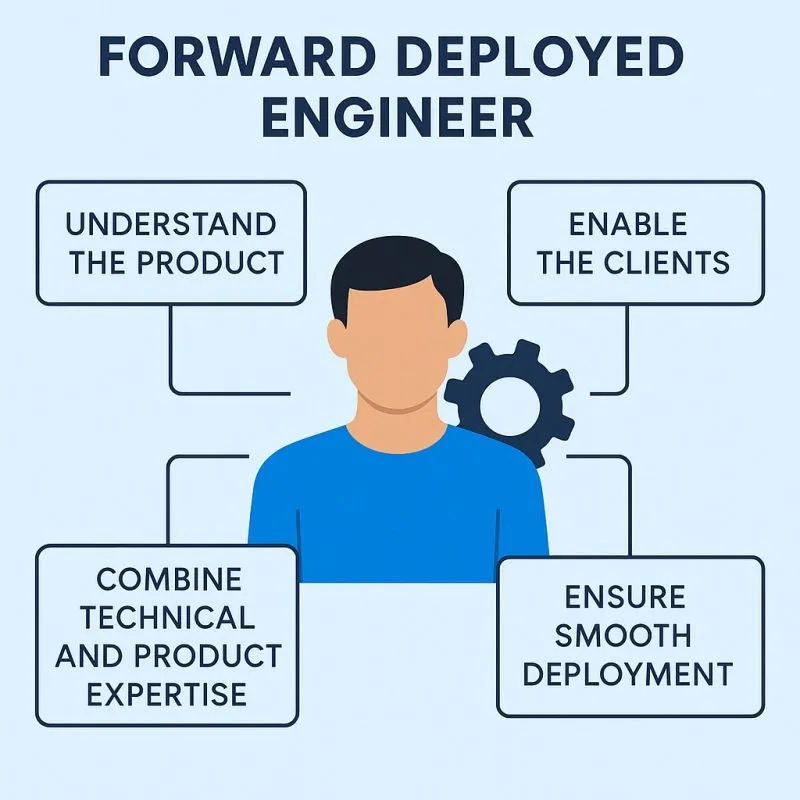
When Fabrica Ventures invested in Palantir Technologies in 2020, one characteristic initially bothered us: its gross margins hovered around ~60%, well below the ~75% benchmark of a typical SaaS company.
Over time, we learned this was not a weakness — it was the price of breaking through one of enterprise software’s hardest barriers: deployment friction.
To solve it, Palantir built an army of Forward-Deployed Engineers, highly technical operators embedded directly with customers, helping implement, customize, and operationalize the software inside complex enterprise environments.
In other words, Palantir sacrificed short-term software elegance for real-world adoption. That tradeoff mattered.
Palantir has, in many ways, become a template for a new generation of software companies — now delivering 85% revenue growth alongside a staggering Rule of 40 score of 145%.
Last week, Anthropic announced a $1.5B joint venture with Blackstone, Hellman & Friedman, and Goldman Sachs. The explicit objective: deploy Forward-Deployed Engineers inside PE portfolio companies and redesign workflows around Claude.
On the very same day, OpenAI announced it was raising $4B at a $10B valuation for an entity called The Development Company, anchored by TPG and Brookfield and structured along similar lines.
The real signal is structural.
The bottleneck for enterprise AI revenue is no longer the lab’s ability to ship a better model. It is the slow work of embedding AI agents alongside knowledge workers inside enterprise workflows.
Both new vehicles effectively say this out loud. They are being built hand-in-hand with PE firms precisely to accelerate deployment across portfolio companies.
The implication is profound: in the next phase of AI, distribution and workflow integration may matter as much as model intelligence itself.
Conclusion
The lesson increasingly seems clear: the future of AI may not belong to the companies with the best models alone, but to those capable of embedding themselves deeply inside customer workflows.
In many ways, the Forward-Deployed Engineer is emerging as a critical layer in the first inning of enterprise AI adoption.
Yet the second-inning question remains open. As one recent WSJ article put it, “Palantir employees said language models are like crude oil, and Palantir is the refinery that makes the models consumable.” But many increasingly believe it may only be a matter of time before the oil learns to refine itself.